A Campus Reading Session for One Casino Scene
A campus reading session for one casino scene helps students trace its structure, compare interpretations and explain how narrative choices guide attention.
The common mistake in a campus reading session for one casino scene is to let the setting dictate the discussion before the group has chosen what to examine. The cost is a broad exchange about casino culture, while the passage’s arrangement of events and attention goes largely unexamined.
At Đại học Bình Dương, a reading group can treat the scene as a crafted sequence: what reaches the reader, in what order, and through whose attention? This keeps the work grounded in the writing. Students need not claim expertise in casino practices to discuss how a passage is built.
Choose a question about the passage’s structure
Set one question the group can answer by looking closely at the text. It might ask how the author delays a piece of information, or what changes when the point of view shifts. A focused question gives everyone a common object of attention without requiring one agreed interpretation.
Select a short passage with a clear opening, a change in the action and an ending. Mark those points before discussion. The aim is not to account for every theme, but to notice how the passage moves from one moment to the next.
Map the reader’s route through the scene
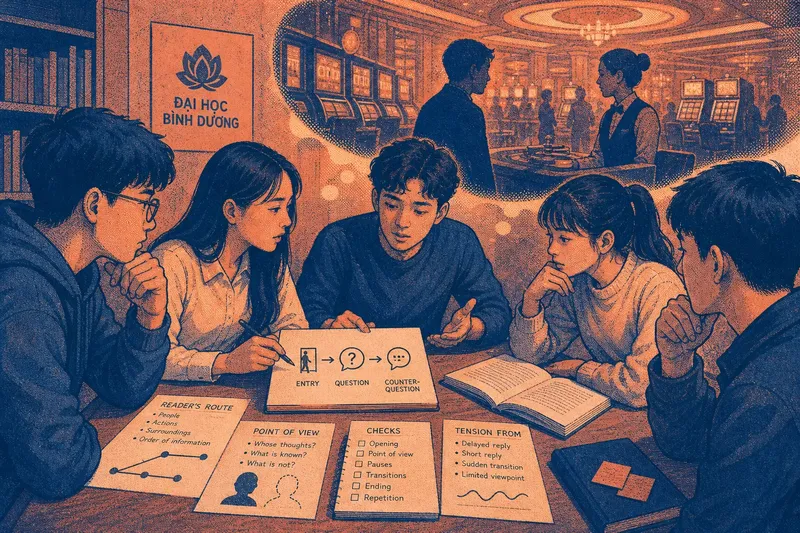
Have students write down the order in which the reader learns about the people, actions and surroundings. Then note what each character appears to know at those points. This is different from making a plot summary: the group is tracking the timing of information.
A useful comparison is a door opened a little at a time. The writer controls what becomes visible, but a gap in the account does not automatically reveal why a character acts as they do. Keep the distinction between what the text states and what a reader infers.
Notice how form creates mood
Tension can come from a short reply, a delayed answer, a sudden transition or a viewpoint that stays close to someone with incomplete information. These are distinct choices, even when they leave a similar impression.
Ask students to point to the sentence, pause or transition that supports their description of the mood. If they call a moment tense, they should identify how the wording or sequence produces that effect. This moves the conversation from a general reaction to an account of the writing.
Work through an invented exchange
Say the group has an invented passage with three starting events: a visitor enters a casino lounge, asks an attendant about a missing friend, and receives a question in reply. The passage gives no explanation of the attendant’s reason for answering that way.
- Write the three events in order: entry, question, counter-question. The visible result is that the attendant’s reply interrupts the expected search for an answer. The group can decide that the exchange redirects attention, but not why the attendant does so.
- Mark the information available to each character. The visitor is looking for a friend; the passage does not state what the attendant knows. The decision is to treat the attendant’s knowledge as unknown, rather than fill the gap with an invented motive.
- Check whether the narration enters either character’s thoughts. In this invented passage, it does not. The group records the narration as externally focused and keeps the attendant’s intention unresolved.
- Compare two readings of the counter-question. It may delay information and hold the reader’s attention, or it may shift attention towards the visitor’s purpose. The group’s answer is that both readings remain possible unless further wording supports one more clearly.
The resulting account is precise: the exchange delays a direct answer, and the narration does not disclose the attendant’s reason. The group has described a formal choice without presenting an imagined motive as fact.
Use these checks to direct discussion
For each feature, note what is present and decide which line of discussion follows. If the passage does not contain the feature, use the alternative rather than forcing an interpretation.
- Opening: Check whether the passage begins before the central exchange. If it does, discuss how the preparation shapes expectation; if it begins mid-conversation, examine what context is missing instead.
- Point of view: Check whose thoughts the narration makes available. If it enters one character’s mind, trace how that access shapes the reader’s knowledge; if it enters no one’s mind, discuss the distance this creates.
- Pauses: Check whether a reply is delayed or interrupted. If it is, consider how the pause changes the rhythm; if not, look to sentence order or description for another source of tension.
- Transitions: Check whether the passage moves between places or moments. If it skips time, ask what the omission leaves out; if it stays continuous, examine how uninterrupted action affects the pace.
- Ending: Check whether the final line resolves a question raised earlier. If it does, discuss what the resolution changes; if it does not, identify which uncertainty remains with the reader.
- Repetition: Check whether a word, gesture or object recurs. If one does, compare its uses; if none does, look for a contrast between details that gives the scene a similar structure.
Which questions help readers discuss narrative craft?
How can students discuss suspense without guessing motives?
Track when information arrives and what remains unknown at each point. That describes the reader’s experience without treating suspense as evidence of a character’s intention.
What if the casino details are unfamiliar?
Students can still examine sequence, viewpoint, dialogue and description without claiming expertise in casino practices. If a game rule is necessary to understand a specific passage, record it as an unanswered context question.
How should a group handle competing readings?
Ask each reader to identify the detail that supports their interpretation, such as a delayed reply or a change in narration. Keep both readings open when the passage does not settle the difference.
What should participants take away from the session?
Each person can note one observation about how the writing directs attention and one uncertainty the passage preserves. That gives the group a concrete record without requiring agreement.
Match the session format to the group
Readers new to close analysis can begin by mapping the order of information, then consider viewpoint. A group accustomed to literary discussion might start with transitions or compare the passage’s opening and ending. Either way, keep the text in view and ask how a particular choice shapes the reading.
A campus reading session for one casino scene works best when it leaves students with a clear account of the passage’s design. One useful last question is what the scene chooses not to explain: the answer can show where the writing leaves room for readers, without asking them to turn that space into certainty.