Film Casino Scenes and Classroom Prompts: A Worked Comparison
Compare film casino scenes and classroom prompts to help students analyse screen craft, inspect a prompt’s conditions and keep each conclusion within its scope.
The common mistake in a lesson comparing film casino scenes and classroom prompts is to ask which feels more realistic. That question costs students a useful distinction: a film arranges images and sound, while a prompt sets out a task in words. At Đại học Bình Dương, students can examine both without treating either as a substitute for evidence about actual casino venues.
Begin with what is physically on the page or screen. A camera movement belongs to the film’s construction. A stated condition or omitted detail belongs to the prompt’s wording. Keeping those observations in separate piles is like sorting receipts before checking an account: it makes the next judgement easier to trace.
Film casino scenes make screen craft available for analysis
In a fictional casino scene, framing directs attention. A close-up of a hand placing a chip emphasises the gesture; a cut to a character’s face shifts attention to a reaction. Editing and sound may make a pause feel tense. They do not, by themselves, explain a game’s rules or establish how people behave in real venues.
Students can note what appears and sounds, then connect each observation to a limited interpretation. A sustained shot, for instance, may delay the story’s resolution. It does not support a claim about how often people hesitate at a roulette table.
Classroom prompts make their stated conditions easier to inspect
A fictional classroom prompt might name a choice and ask students to say what follows. Its wording lets them identify which terms are defined and which details are absent. That boundary matters: an answer should use the information supplied, not quietly fill gaps with assumptions.
A prompt need not imitate a casino’s atmosphere. If the lesson asks how a question is framed, mood and staging may pull attention away from the wording. The useful comparison is not which format feels more complete, but what each lets students examine.
Choose the material that fits the learning question
Use a film scene when students are examining camera work, editing, sound, performance or storytelling. Use a written prompt when they are inspecting stated terms, assumptions or missing conditions. If both appear in one lesson, assign them separate tasks so that observations about screen craft do not become claims about real venues.
- Check the learning aim: If the question concerns editing, framing or performance, choose a scene and ask students to cite the moment; if it concerns a defined problem, choose a prompt and ask them to identify its conditions.
- Check the source type: If the material is fictional, keep conclusions about its representation; if it records real events, identify what the recording covers and use another source if the question extends beyond it.
- Check whether the needed rules are stated: If the prompt supplies them, ask students to apply those terms; if it does not, mark them as unknown and find a suitable explanation before asking for an answer that depends on them.
- Check the task wording: If the task asks about sound, camera or character, direct attention to those features; if it asks about a concept, state the prompt’s conditions or revise the question.
- Check claims about actual venues: If a student moves from a fictional scene to a claim about real casino practice, ask for an appropriate source; if none is available, keep the claim about the scene.
- Check for competing demands: If atmosphere distracts from a narrow written exercise, separate the scene from that exercise; if atmosphere is itself under examination, retain the scene and state that focus.
How do students compare scenes and prompts?
What can a film scene say about casino culture?
It can show how a story uses images, sound and character behaviour to represent ideas such as risk or belonging. On its own, it cannot establish how people behave in actual venues.
Why pair a film with a written prompt?
The film offers choices in presentation for students to analyse, while the prompt makes its stated conditions available for inspection. Pairing them can clarify the difference between how a story creates meaning and what the written exercise allows a student to conclude.
How should students handle claims beyond the material?
They should name the observed feature and keep the claim within its scope. Claims about actual rules or venues require a source suited to that question, not just a fictional scene or prompt.
Which format should a lecturer choose?
Choose a scene for questions about cinematic choices and a prompt for questions about stated terms. Use both when students are asked to compare those distinct forms of representation.
A worked comparison separates interpretation from inference
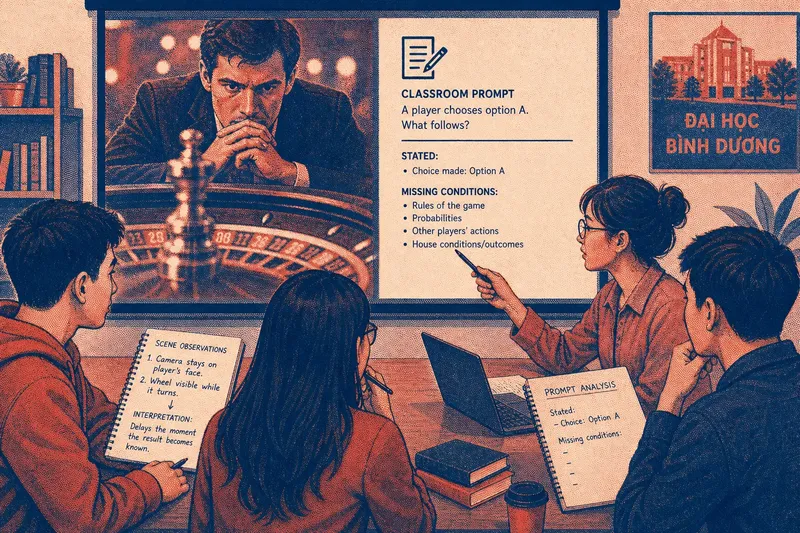
Say a lecturer at Đại học Bình Dương prepares an invented exercise with two starting materials: one fictional roulette scene, where the camera stays on a player’s face as the wheel turns, and one fictional prompt, which names a player’s choice but omits the conditions needed to determine the outcome. The task is to analyse suspense and decide what the written prompt supports.
First, students record two observations from the scene: the camera stays on the player’s face, and the wheel remains visible while it turns. They connect the sustained shot to a limited interpretation: the scene delays the moment when the result becomes known. Next, they underline the single choice named in the prompt and list the omitted outcome conditions. They then answer the two questions separately: the scene creates suspense by delaying resolution; the prompt does not contain enough information to determine an outcome. The trade-off is plain: the scene gives students material for analysing mood, while the prompt makes its missing conditions easier to identify.
Keep each conclusion tied to its material
Film casino scenes and classroom prompts can support different kinds of close reading. A film presents choices in framing, sound, editing and performance; a prompt presents terms and conditions that students can question. The distinction is more useful than asking which format is truer to life.
For a lesson at Đại học Bình Dương, film casino scenes and classroom prompts work best as separate sources with clearly named tasks. When a student’s question shifts from representation to actual rules or venues, the useful next move is to consult a source designed to address that subject.