What a Casino Rule Does Before the First Turn
Casino rules define the choices and sequence available before play begins, helping students read a game’s structure without confusing it with prediction.
The most common mistake in reading casino rules is to treat them as a hint about what will happen. That mistake turns a description of available choices into a prediction, obscuring the game’s actual structure. Casino rules do something more modest and more useful: they specify what a player may do, when they may do it, and how the game proceeds from one decision to the next.
For students at Đại học Bình Dương, that distinction offers a clear way to examine games as designed systems. A rule can make one action available and another impossible; it can establish an order of turns or define how a round ends. None of that tells a player which outcome will occur. To see the difference, read the rules in sequence, as if tracing a path through a room whose doors have already been marked.
Casino rules define the game’s boundaries, not its outcome
Begin by identifying what kind of text you are reading. A casino rule is a statement about permitted actions, timing, or settlement. “A player may stand” is a rule about choice. “The dealer acts after the players” is a rule about sequence. “The round ends when the hand is resolved” describes a boundary. These statements shape play, but none forecasts a particular result.
Rules also have a scope. Some apply to every participant, while others govern a specific role or moment. A rule may say what happens when a player declines an action, or when the dealer must proceed. Read each statement with a simple question: what does this make possible, require, or prevent?
That question keeps interpretation grounded. If a rule says a player can choose between two actions, the rule establishes a choice, not which option is better in every situation. If it sets an order, it tells you who acts first, not what those people will decide.
Casino rules are easiest to read in four passes
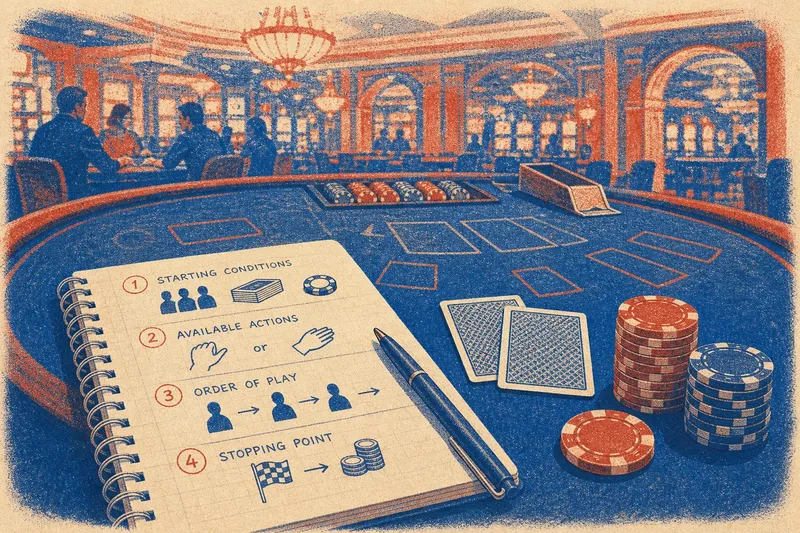
Use the following sequence when you encounter a game’s rules in a casino scene, a classroom exercise, or a printed description. The point is not to memorise rules by force. It is to separate the parts that govern play so each can be understood on its own.
- Find the starting conditions. Note what must be in place before a round begins: who is playing, what objects are used, and what initial state the rules establish. Do not add assumptions that the text does not provide.
- List the available actions. Record what each participant may choose to do. Mark the difference between permission (“may”) and obligation (“must”). If a choice is not named, do not assume it is allowed.
- Trace the order of play. Identify who acts, when the next participant acts, and what event moves the game to its next stage. Arrows or a short numbered sequence can help make the order visible.
- Locate the stopping point. Find the condition that closes a round or moves it into resolution. Note what the rules say happens next, without treating that procedure as a forecast.
Imagine a student in a seminar is given a short, invented description of a table game. It says each player begins with a set of cards, may either draw or hold, and acts in turn before the dealer resolves the remaining hand. The student writes down the starting state, the two options, the order of turns, and the closing procedure. The expected observable result is a clear map of what players can do and when—not a claim about which hand will win.
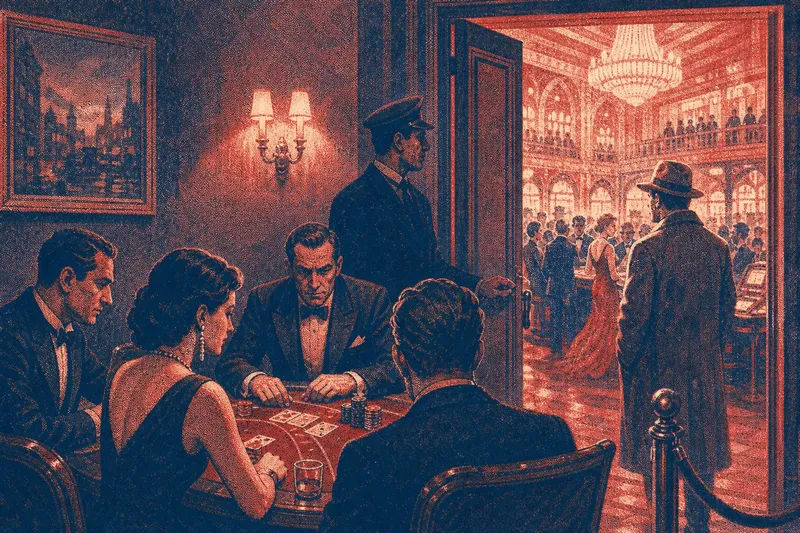
This order resembles following a set of room instructions: first locate the entrance, then note which doors are open, then see where the route ends. The map can describe the available passage without telling you who will walk through it.
Separate choices, sequence, and settlement
Once the rules are mapped, sort them into three categories. This prevents an action from being confused with its timing, or a closing procedure from being mistaken for a prediction.
- Choices describe what a participant is permitted to do. Look for language such as “may choose” or “can take.”
- Sequence describes the order in which actions occur. Look for “before,” “after,” “in turn,” or a stated order of roles.
- Settlement describes how the game records or resolves an end state. It explains what the procedure does once the relevant conditions are met.
A rule can belong to more than one category, but separating them is still helpful. For instance, a statement might allow a player to take an action only before another role acts. It defines a choice and limits its timing. Record both parts rather than flattening the statement into “the player can act.”
Keep the words of the rule close to your notes. A brief quotation or faithful paraphrase lets you check whether your interpretation adds a condition that was never stated. In a class discussion, this is more useful than arguing from a vague impression of how the game “usually” works.
Rules create structure without predicting chance
Chance concerns which outcome occurs among the possibilities a game permits. Rules determine the shape of that possibility space: they set actions, order, and boundaries. The two ideas interact, but they are not interchangeable.
If a game allows a player to choose between actions, the choice changes the route play can take. It does not make a later result certain. Likewise, an ordered sequence can clarify who acts next while leaving the eventual outcome unresolved. Reading the rule carefully means stopping at what it establishes.
This distinction matters in university learning because games often invite confident explanations after an outcome is known. A student may see a result and then describe it as if the rules had pointed towards it all along. A better reading starts before the outcome: list the options, trace the order, and keep any claims about chance separate from claims about procedure.
When discussing a casino setting, this approach also keeps attention on design rather than mystique. The rule is not a secret signal. It is a public constraint that helps participants understand what counts as a valid move and when the next part of play begins.
What should you ask before the first turn?
Does a rule tell me what a player may do?
Yes, when it grants permission or names an available choice. Treat that as a boundary on action, not a recommendation about which choice to make.
How can I tell whether a rule sets the order of play?
Look for language that marks timing or turn order, such as “before,” “after,” or “in turn.” Rewrite the sequence plainly, but do not infer an outcome from the order alone.
Does the rule reveal who will win?
No. A rule can define how a result is recognised or settled, but it does not identify the result in advance. Keep prediction separate from the game’s stated procedure.
What should I do if the rule leaves something unclear?
Mark the gap rather than filling it with an assumption. Check the full rule set or the relevant game materials, and explain which point remains unspecified.
Use a compact rule map for class discussion
A useful class note can fit on one page. Put the game’s starting conditions at the top, then add three columns labelled choices, sequence, and settlement. Place each relevant rule in the appropriate column, using short wording and a reference to where it appears in the material.
Then add a final line called “not established”. Put predictions, motives, or customary practices there if the written rules do not support them. This is not a way to dismiss those ideas; it is a way to keep them distinct from the rules themselves. A discussion can then ask whether an interpretation comes from the text, from an added assumption, or from an observation about a particular outcome.
For a seminar comparing several descriptions, use the same map for each one. Differences become easier to see: one version may offer a choice at a stage where another does not, or may place a role earlier in the sequence. Describe those differences precisely before discussing their effects.
Check the wording before you draw a conclusion
Before presenting your reading, make a final pass through the material:
- Check the verbs. Distinguish “may” from “must” and “can” from “will”.
- Check the actors. Confirm who is permitted or required to act at each point.
- Check the order. Make sure the sequence follows the stated timing, not an assumed convention.
- Check the boundary. Identify the condition that ends the relevant stage.
- Check your claims. Remove any prediction that the rules do not actually make.
If the written rules refer to a specific game edition or table procedure, consult that version rather than combining it with another description. Where interpretation depends on the wording supplied by a particular publisher or venue, that wording is the relevant source for the exercise.
Casino rules are most revealing when read before the action begins. They tell a student which doors are open, which must remain closed, and in what order the room can be crossed. That map makes the game easier to discuss without pretending it has already disclosed the destination.
When you next read casino rules, keep the main question close: what does this sentence permit, order, or resolve? That small discipline makes the structure visible while leaving chance where it belongs—in the uncertain outcome, not in the rule that frames it.